Why an Inverter AC is the Best Choice for Indian Homes
If you are deciding between a normal (fixed-speed) AC and an Inverter AC, the choice in 2026 is clear. While the initial price of an Inverter AC is higher, the long-term benefits in comfort and electricity savings make it the cheapest option to own over its lifetime.
1. Massive Electricity Savings
The primary advantage of an Inverter AC is its ability to save power. The graph below illustrates the critical difference in how Inverter and Non-Inverter air conditioners manage room comfort - that is the steady room temperature without becoming too cold or warm while you are sleeping.
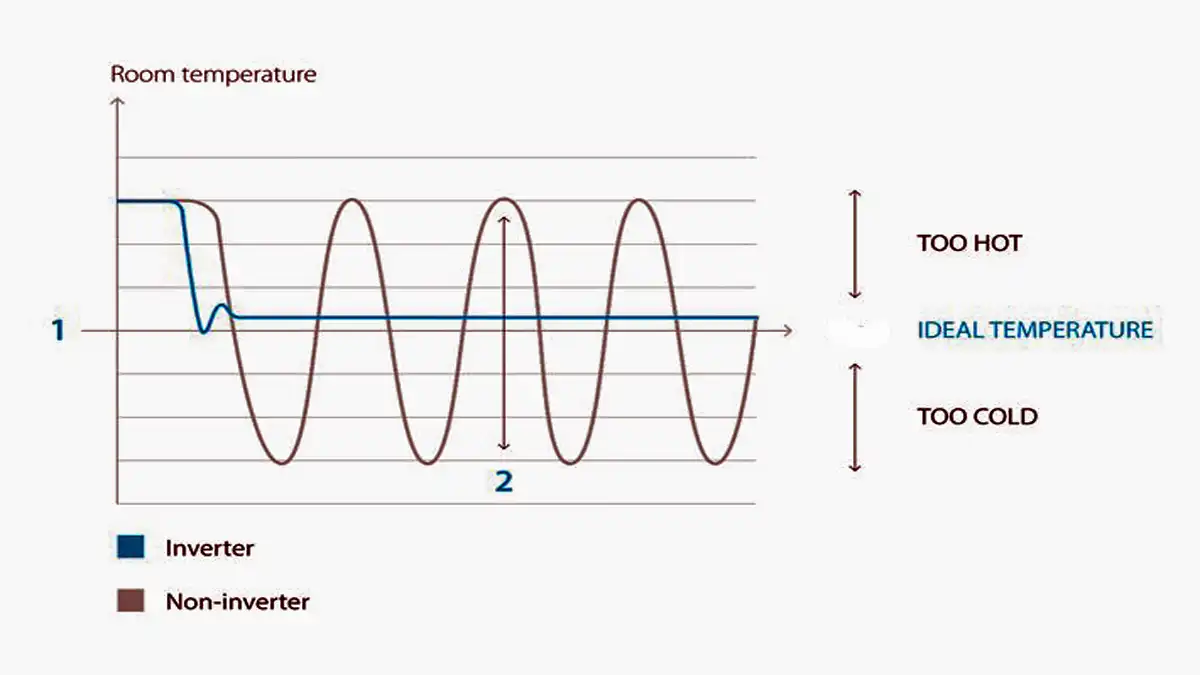 Graph comparing room temperature stability of Inverter AC vs Non-Inverter AC
Normal (Non-Inverter) AC: The "Stop-Start" Cycle A traditional AC operates at a fixed speed—it is either 100% "On" or completely "Off". To maintain a set temperature of say 23°C, it will over-cool the room by -2°C to 21°C before the compressor shuts off. The room then warms up to +-2°C until it hits 25°C, at which point the compressor restarts with a loud 'clunk' sound. This 4°C fluctuation leads to "hot and cold" spots and higher energy waste.
Inverter AC: The "Steady-Flow" Method, An Inverter AC uses a variable-speed compressor that never truly stops. It slows down to a "crawl" once the room is cool, maintaining the temperature within a precise ±0.5°C range. Thus the Inverter ACs has a variable speed compressor, allowing it to be a 0.15 Ton to 2.25 Ton AC as needed. This also eliminates the noisy 'clunk' sound of stop and restart which disturbs your sleep and creates a far more comfortable, consistent environment.
How Inverter Technology Saves You Money
-
Slow speed less friction loss: Instead of running at full blast, an Inverter AC adjusts its speed to match the cooling load. Since friction and heat losses are lower at slower speeds, the machine operates much more efficiently.
-
No "Starting Current" Spikes: Most power is consumed when a motor starts from a dead stop. Every time a normal motor starts, it consumes a massive surge of electricity. By avoiding frequent restarts, Inverter ACs can reduce your power bill by 30% to 50%.
2. Superior Cooling Comfort
A normal AC works by cooling the room until it hits -2°C of the set temperature, then turning off. The temperature then rises until it is +2°C of set temperature and the AC comes back on. This leads to a "yo-yo" effect where the room is either too cold or too warm.
- Stable Temperature: An Inverter AC maintains the room temperature within a very narrow range (usually +/- 0.5°C).
- Faster Cooling: When you first turn it on, the inverter compressor can run at "Turbo" speeds (up to 120% capacity) to cool the room down significantly faster than a standard AC.
3. Silent Operation
Because the compressor in an Inverter AC doesn't constantly make a loud noise when coming on and off at full power, the outdoor unit is significantly quieter. This makes it the perfect choice for bedrooms where a peaceful sleep is a priority.
4. Better for Home Inverters and Solar
Since an Inverter AC does not have a massive "startup current" surge, it is much friendlier to home backup systems.
-
Low Startup Current: A 1.5 Ton Inverter AC can often start and run on a sufficiently rated home UPS or a solar power system that would otherwise trip if a normal AC tried to start.
-
See prices of latest 5 Star ACs available in India.
🛒 5 Star ACs on Amazon
💰 The "Payback" Period
Many buyers worry about the higher upfront cost of an Inverter AC.
In a typical Indian household:
- Extra Cost: ₹5,000 to ₹8,000 more than a normal AC.
- Monthly Savings: ₹500 to ₹1,000 during summer months.
- Payback: You will typically recover the extra investment in 1.5 to 2 years through lower electricity bills.
Note that the Bureau of Energy Efficiency (BEE) upgrades the energy Standards required to become 5 Star rated. For example, a 5-star AC or a Refrigerator from 2020 would likely only qualify as a 3-star unit under the 2026 standards.
ADVERTISEMENT
What to Read Next: